




 Find an institute
 Offer a treatment
 Find an institute
 Offer a treatment
In a skincare routine, the effectiveness of a hydrating serum largely depends on how it is used. Overly harsh cleansing, incorrect application order, layering too many products, or choosing an unsuitable formula can all limit its benefits for the skin. Here are some insights into what truly helps the skin, and what, on the contrary, can hinder hydration.
Hydrating serum: understanding its role in your routine
A hydrating serum is not simply a “lighter moisturizer.” Within a skincare routine, it is a treatment product, generally more fluid in texture, applied after cleansing and before moisturizer. The recommended order is therefore: cleanser, toner, serum, moisturizer.
From a scientific perspective, skin hydration relies on several complementary mechanisms. Humectants attract water into the stratum corneum, emollients soften the skin’s surface, and occlusives help limit transepidermal water loss. Recent dermatological reviews emphasize that an effective moisturizer works both by increasing the skin’s water content and by improving its ability to retain that water. This is why a facial hydrating serum can be highly beneficial but may not always be sufficient on its own if the skin also requires a product that helps “seal in” moisture.
It’s also important to remember that dehydrated skin is not necessarily dry skin. All skin types can lack water, including combination and oily skin. For example, the Hydra range by Guérande Cosmétiques is designed for all dehydrated skin types. This distinction is essential: you may need a hydrating serum even if your skin produces excess sebum.
The table below summarizes the roles of different types of hydrating skincare:
| Product type | Main role | What it doesn’t always replace |
| Hydrating Serum | Delivers humectants and targeted active ingredients in a lightweight texture | A moisturizer when the skin also needs emollients or occlusives |
| Moisturizer | Often combines humectants, emollients, and sometimes occlusives | A targeted treatment for specific concerns |
| Oil or Balm | Primarily reduces water loss and softens the skin | Humectants when the skin lacks water |
This summary aligns with dermatological literature: a facial hydrating serum focuses on delivering active ingredients, while a moisturizer more fully supports the skin barrier.
Facial hydrating serum: the mistakes that truly limit its effectiveness
When a facial hydrating serum seems not to “work,” the issue is not always the formula itself. More often, it is the surrounding routine that limits its effects. Here are the most common mistakes.
Applying the serum to poorly prepared skin
First, the skin should be clean but not stripped. Gentle cleansing before skincare is recommended. Conversely, overly abrasive, heavily foaming, or alcohol-based cleansers can impair the skin barrier. For both dry and oily skin, dermatologists discourage harsh cleansers because they may increase irritation, dryness, or even trigger excess sebum production.
Using too little, or far too much
Another common mistake is assuming that more product means better results. There is no universal dosage for all serums, as this depends on texture, delivery system, and the area being treated. In practice, the right amount is enough to cover the face and neck in a thin, even layer, following the brand’s recommendations. Using too many products or too many steps can become irritating, making the skin less comfortable and less receptive.
Layering irritating products around your hydrating serum
A third mistake is talking about “incompatibilities” when the real issue is often cumulative irritation. A hydrating serum containing hyaluronic acid or glycerin is not inherently difficult to combine with other ingredients. However, adding overly frequent exfoliants, poorly tolerated retinoids, benzoyl peroxide, aggressive AHAs, irritating fragrances, or detergents such as sodium lauryl sulfate can weaken the skin barrier. A compromised barrier loses water more easily and becomes more reactive. Exfoliation, especially when combined with already sensitizing products, may increase dryness and irritation. Sensitive and reactive skin types should be particularly cautious with fragrances and harsh detergents.
Applying moisturizer before serum
Another mistake is applying a rich moisturizer before your facial hydrating serum. Moisturizers are designed to seal in hydration and generally have a heavier texture than serums. Applying a thicker or more occlusive product first may alter how the serum is absorbed. In other words, application order matters and can influence the penetration of active ingredients.
Over-exfoliating to “improve absorption”
Finally, trying to “open up the skin” at all costs is not a good idea. Gentle exfoliation can be part of a well-designed routine, but frequent or aggressive exfoliation is not recommended, as it may lead to redness and irritation. The skin’s pH and acid mantle play a central role in maintaining barrier integrity, and overly aggressive routines may ultimately produce the opposite of the desired effect.
How to maximize the effectiveness of a hydrating serum
For a hydrating serum to perform at its best, it should be viewed as one part of a coherent routine rather than as a miracle product. The first rule is consistency: hydrating skincare works best when used regularly. Cleansing, followed by a targeted treatment such as a hydrating serum, and then hydration and/or nourishment adapted to your skin type already forms a solid morning and evening routine.
The second rule is to complement the serum with a suitable moisturizer. Effective skincare often combines humectants with ingredients that reinforce the skin barrier and reduce water evaporation. In other words, the serum provides the boost, while the moisturizer prolongs and stabilizes hydration. For oily skin, the moisturizer may be very lightweight; for dry skin, it may be richer.
The third rule is to adapt your routine according to your skin’s tolerance. Best practices include:
– Cleansing with a gentle product, without overwashing or rubbing
– Applying toner, then hydrating serum, then moisturizer
– Using sun protection whenever exposed to sunlight, as UV exposure damages skin quality and accelerates visible signs of aging
– If tolerated, following a weekly ritual that remains reasonable: gentle cleansing, non-aggressive exfoliation, a hydrating mask, followed by toner, serum, and moisturizer
– Stopping and reassessing the routine if persistent redness, stinging, or burning sensations occur
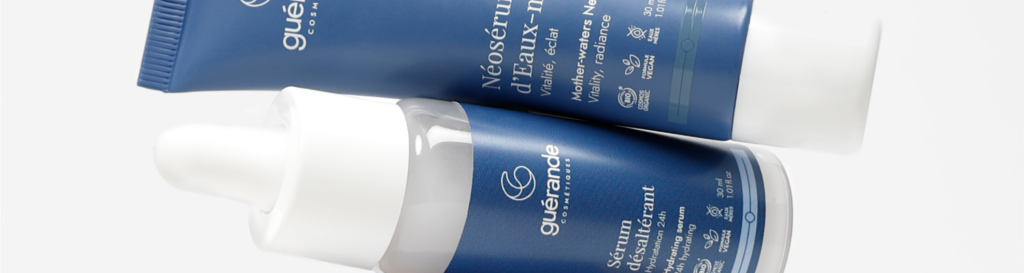
At Guérande Cosmétiques, the Hydra routine perfectly illustrates this philosophy. The Hydrating serum is a true hydration concentrate for all skin types, formulated with ingredients known for their hydrating properties: Green Salicornia, Enteromorpha Macro-Algae, Hyaluronic Acid, and Sodium PCA.
In most cases, a hydrating serum alone is not enough. It delivers targeted active ingredients, but a moisturizer remains useful to strengthen the skin barrier and limit water loss. The facial hydrating serum should be applied morning and evening, immediately after cleansing and before moisturizer.
Which facial hydrating serum should you choose according to your skin type?

Choosing a facial hydrating serum only makes sense when you take into account your skin type, sensitivity, and individual circumstances. Dermatology does not recommend the same textures for dry, oily, or reactive skin.
For dry skin, the goal is to increase water content in the stratum corneum while supporting the skin barrier. Formulas rich in ingredients such as Glycerin or Hyaluronic Acid can be combined with richer creams or balms to help retain moisture.
For oily skin, avoiding hydration is a mistake. Oily skin can also be dehydrated and benefits from lightweight, non-comedogenic formulas. A light hydrating serum followed by a suitable fluid moisturizer is often preferable to a very rich cream.
For sensitive skin, products should be carefully selected according to the skin’s condition. Testing the product on a small area is recommended, especially for reactive or allergy-prone skin. Particular caution should be exercised with potentially irritating ingredients such as fragrances and essential oils.
Comparing hydrating serum ingredients
Not all “hydrating” ingredients offer the same level of scientific evidence or work in the same way. When choosing a hydrating serum, it is useful to distinguish well-documented humectants from botanical or marine ingredients that are promising but less standardized.
| Ingredient | Benefits |
| Hyaluronic Acid | Major humectant; contributes to hydration and suppleness, with effects varying according to molecular weight. Supported by multiple clinical studies. |
| Glycerin | A classic humectant that improves hydration, skin softness, and barrier repair. Well documented in dermatology. |
| Enteromorpha Macro-Algae | Rich in antioxidant polyphenols and fructo-oligosaccharides that help maintain hydration. |
| Green Salicornia | Rich in amino acids that support the maintenance of skin hydration. |
Recent literature on Hyaluronic Acid shows that its effects depend greatly on its form and molecular weight, while Glycerin remains a benchmark ingredient for hydration and barrier repair. Marine-derived ingredients such as Enteromorpha Macro-Algae and Green Salicornia contribute to maintaining hydration.
Conclusion
A hydrating serum is only truly effective when incorporated into a coherent skincare routine: gentle cleansing, proper application order, minimal irritation, a suitable moisturizer, and reasonable exfoliation frequency. The best facial hydrating serum is therefore one that is effectively formulated, well tolerated by your skin, used consistently, and combined with a routine that respects the skin barrier. When chosen and used correctly, it becomes a valuable ally for achieving radiance, comfort, and suppleness every day.